Federal broadband funding is one of the largest infrastructure opportunities in recent history. But with that opportunity comes scrutiny, deadlines, and compliance pressure.
For many internet service providers (ISPs), the Broadband Data Collection challenge process is complex, time-consuming, and high-risk. Missing service locations can mean lost funding. Incorrectly listed locations can open the door for competitors to claim dollars in markets you already serve.
One regional ISP faced exactly this challenge.
Their solution? A streamlined, visual GIS-based system that reduced their challenge timeline from months to less than three weeks, while improving Federal broadband funding accuracy and internal efficiency.
The Problem: No Clear Process, High Stakes, and Manual Workarounds
The FCC’s Broadband Data Collection (BDC) process requires ISPs to review the federal broadband “fabric,” a dataset of serviceable locations, and submit formal challenges when discrepancies are found.
These discrepancies can take many forms depending on the ISP, including:
- Missing broadband serviceable locations
- Incorrectly classified structures
- Duplicate or secondary buildings
- Locations that should not be considered serviceable
For this ISP, the biggest issue wasn’t just complexity; it was the lack of a defined, repeatable process.
Before working with UtiliSource, their approach looked like this:
- No standardized workflow for verification
- Heavy reliance on spreadsheets and manual review
- Multiple teams working in silos
- External engineering firm involvement for queries and submission formatting
What That Looked Like in Practice
- 6 internal team members spent 3-4 weeks reviewing records manually
- Several thousand records were identified for removal
- Only ~1,200 records were ultimately submitted successfully
- Engineering firm queries were later found to be unreliable
- Data had to be re-reviewed and reprocessed
The process created bottlenecks at every stage:
- Data validation
- Internal coordination
- Submission formatting
- External dependencies
In short, there was effort, but not efficiency.
The Solution: A Visual, Self-Contained System for Faster, Smarter Verification
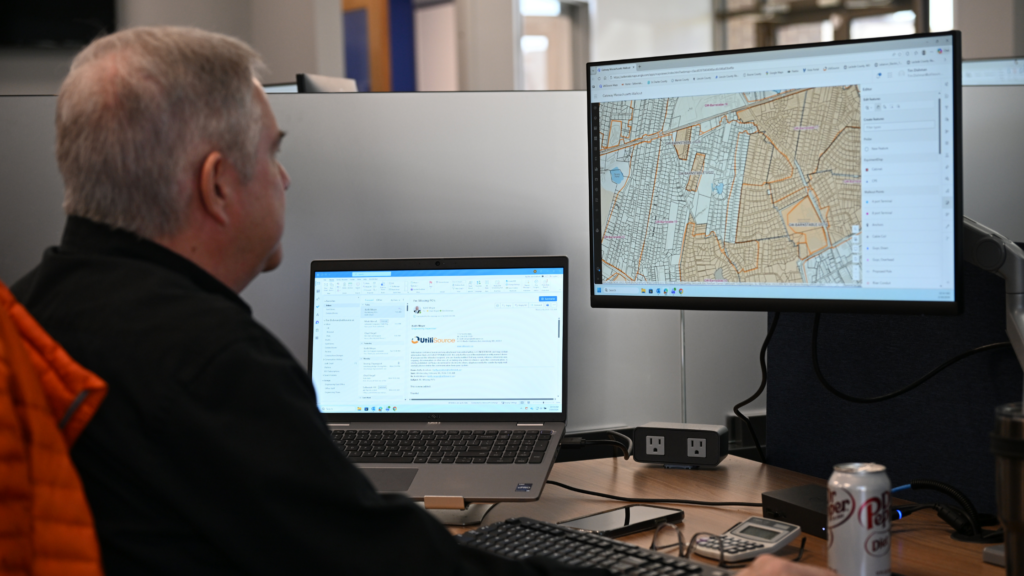
UtiliSource developed a browser-based solution designed to simplify and accelerate the Broadband Data Collection challenge process, without requiring deep GIS expertise.
Instead of relying on fragmented workflows and external partners, this system allowed the ISP to bring the entire process in-house.
Key Capabilities
- Layered Visualization
ISP service data aligned directly with federal fabric data
- Aerial Imagery Integration
Staff could verify locations without defaulting to field visits
- Distributed Access via URL
Multiple users could work simultaneously without overlap
- Automated Output Templates
Challenge data was generated in submission-ready formats
Measurable Impact: From Fragmented Effort to Scalable Execution
With the new system in place, the ISP transformed both speed and scale.
Real Results
- 4,097 service points reviewed
- Timeframe: September 5 – October 10 (just over one month)
- Automated CSV exports formatted for federal submission
- No need for manual template creation or external processing
Efficiency Gains
Compared to their previous process:
- Eliminated spreadsheet-based coordination across multiple users
- Removed need to consolidate and reconcile multiple files
- Reduced dependency on third-party engineering firms
- Combined verification and submission preparation into a single workflow
What Changed Operationally
Instead of:
- Multiple users working in separate files
- Submitting data to a central reviewer
- Sending final lists to an external firm
- Rebuilding submission templates from scratch
The team could now:
- Work in a shared environment
- Target specific records efficiently
- Generate submission-ready outputs automatically
- Complete verification and documentation in one step
Client Feedback
The impact was immediate:
“We were able to target specific records and by answering the forms, automatically generated the output templates. The ease of the map setup allowed for faster coverage by multiple people without overlapping… very efficient compared to everyone working in Excel files.”
Built for Flexibility and Future Expansion
One of the most important aspects of this solution is its adaptability.
Rather than being locked into a specific challenge type or dataset, the system is designed to evolve alongside ISP needs.
- Supports multiple types of broadband fabric challenges
- Configurable to different datasets and requirements
- Expandable for future funding cycles and submissions
“The map can be expanded to cover subsequent challenges as we move forward… future expandability is built in.”
Why Traditional Broadband Mapping Tools Fall Short
Many ISPs rely on enterprise-level GIS platforms. While powerful, these systems often:
- Require specialized training
- Limit access to technical teams
- Create bottlenecks in collaboration
- Lack built-in compliance workflows
This is where modern Broadband mapping tools and GIS tools for broadband funding must evolve.
The difference isn’t just technology, it’s usability.
This solution enabled:
- Non-GIS users to participate
- Parallel workflows without duplication
- Faster validation without sacrificing accuracy
Improving Broadband Funding Compliance and Accuracy
At its core, this solution is about more than speed.
It ensures:
- Accurate representation of serviceable locations
- Defensible submissions for federal review
- Protection against competitors claiming funding in served markets
By aligning internal data with federal datasets and generating submission-ready outputs, ISPs can significantly improve Broadband funding compliance and overall funding outcomes.
A Shift from Mapping to Strategy
This case reflects a broader shift in how GIS should function within broadband organizations.
Not just:
- Mapping
- Data storage
- Visualization
But:
- Compliance enablement
- Funding protection
- Operational efficiency
- Strategic decision-making
In today’s environment, accurate, defensible data determines who wins, and who gets left out.
The Broadband Data Collection challenge process allows ISPs to dispute inaccuracies in the federal broadband fabric. Challenges can include adding missing service locations or removing invalid ones that do not accurately reflect service availability.
Challenges vary by ISP but may include:
Adding missing serviceable locations
Removing abandoned or invalid structures
Correcting classification of buildings
Updating serviceability status
Inaccurate data can result in:
Lost funding eligibility
Misallocated resources
Competitors receiving funds in already-served markets
Compliance complications
Ensuring Broadband funding compliance directly impacts revenue and long-term infrastructure investment.
Traditionally, many ISPs rely on advanced GIS systems. However, web-based solutions can simplify the process and reduce reliance on specialized software, making GIS tools for broadband funding more accessible across departments.
Timelines vary widely depending on dataset size, internal coordination, and process maturity. Many organizations report multi-month review cycles. With a structured visual verification approach, timelines can be significantly reduced.
Yes. By leveraging layered aerial imagery and integrated datasets, many discrepancies can be resolved from the office. Field visits can then be reserved for ambiguous or high-risk cases.
By aligning ISP service data directly with federal fabric data and formatting exports precisely for submission, this method reduces errors, ensures defensibility, and supports compliant funding applications.
Yes. The system is designed to be accessible and collaborative, making it suitable for organizations without large in-house GIS teams. Deployment details and onboarding requirements can be customized.
If your organization is preparing for the next funding cycle and looking to improve your Broadband Data Collection challenge process, now is the time to ensure your data is accurate, defensible, and submission-ready.
For more information about how UtiliSource supports broadband providers through advanced mapping and compliance solutions, contact our team.